
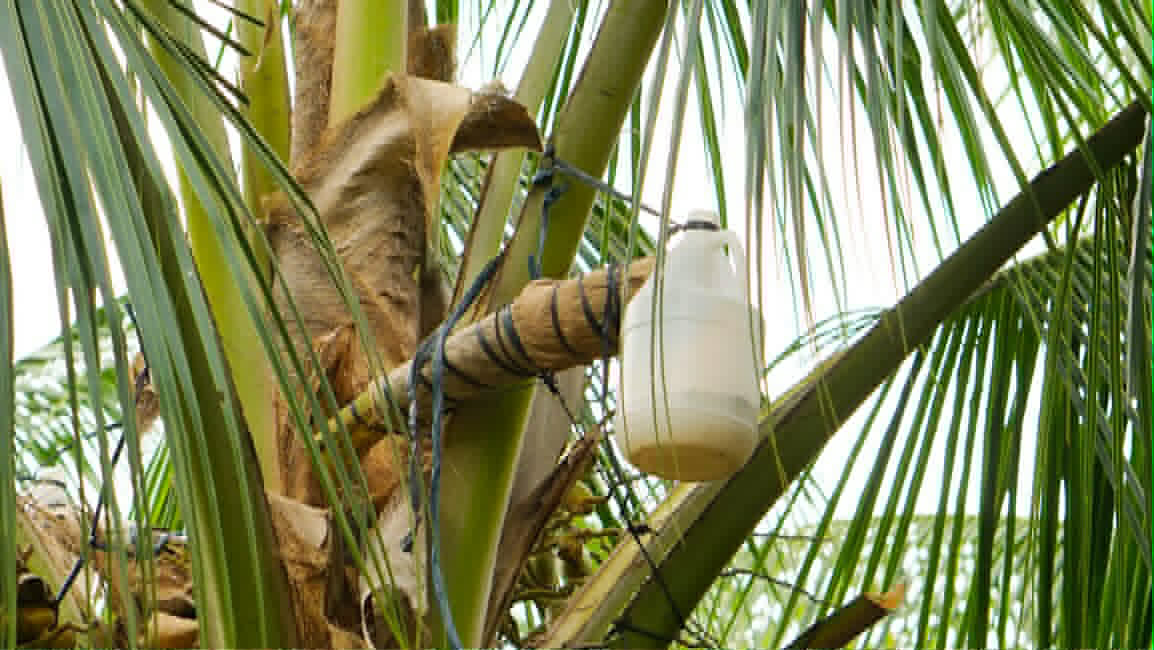
In copra farming, you harvest when the nuts are ready and get paid roughly once a quarter. That has been the standard arrangement for coconut farmers in Misamis Oriental for decades. T2G runs on a different rhythm. Coconut tappers collect sap every four to five hours throughout the day, from 5am to 6pm. They get paid every week. That one change in payment schedule has made a real difference in how the farmers and tappers T2G works with live their lives.
Tatay Henry's Wednesday Deliveries
Tatay Henry Yecyec farms in Barangay Linabo, Balingasag. He has a lot of coconut land, though he's quick to say that's not the point. "Ang akong yuta, dili sa pang hinambog, daghan man hinoon akong kalubihan, pero isa ra ka tao akong tapper." Not to boast, but a lot of trees, and just one tapper working them.
A friend pointed him toward T2G. He now delivers five containers of coconut sap every Wednesday. Each container is worth PHP 1,750, which works out to PHP 8,750 per delivery. For his tappers, the shift from copra's quarterly payout to a weekly wage changed things noticeably. "Hayahay na ang sweldo kay kada semana naman," he says. The wages are more stable because they come regularly now.
Tatay Henry joined PAGSAKA, T2G's partner cooperative (Pag-Ugmad sa Kaugmaon Agriculture Cooperative), as a member alongside becoming a supplier. He describes supplying coconut sap as a sideline, something he does partly to support the tappers who work for him. "Gusto ko makatabang sa akong isig katao." He wants to help his fellow farmers. The cooperative structure lets him do that at a scale that copra farming didn't allow.
Jimrex Cinco: From Construction Site to Coconut Tree
Jimrex Cinco used to work construction. He was away from his family, earning PHP 300 a day, and making enough to get by. "Makakaon man japon pero lahi rajud sa karon." They could eat. But it was different from what life is now.
Now he's a coconut tapper for T2G and a PAGSAKA member. In a day, he climbs each tree four times. After each collection, the sap gets pre-boiled in a wok to stop it fermenting, then transferred to containers for Wednesday delivery. His weekly income at T2G is PHP 4,000 to PHP 5,000.
"Sa isa ka adlaw, ka-upat mi musaka sa lubi. Kada saka ug inig naog, ipa-bukal ang tuba hangtod ma syrup. Pagkahuman, gikan sa kawa, amo nang ibalhin sa container para ma-deliver." In a day, we climb the coconut tree four times. After collecting the coconut sap, we boil it in a wok until it becomes syrup. Then we transfer it to containers for delivery.
He has one main dream: send his children through school. "Akong pangandoy, akong gusto, akong mga bata, makalampos." His prayer is that the cooperative grows so more tappers can join, because right now there are farmers in the area without buyers. He was one of them before T2G.
The Income Numbers
| Work Type | Pay Cycle | Estimated Monthly Income |
|---|---|---|
| Copra farming | Quarterly | Lower, less predictable |
| Construction (Jimrex, before) | Daily at PHP 300 | Approx. PHP 6,000 to PHP 7,500 |
| Coconut sap tapping (T2G) | Weekly | PHP 16,000 to PHP 40,000+ |
The PHP 40,000 figure comes from Gemma Dela Vega-Emata, T2G's Managing Director, who uses it as an example of what a coconut farmer can earn monthly from sap. Copra from the same trees cannot produce that kind of yield or frequency.
The Gap T2G Cannot Fill Yet
T2G currently works with 25 to 30 tappers from barangays in Balingasag, Claveria, and Jasaan. The enterprise cannot take on more suppliers right now, not because the demand isn't there, but because working capital limits how much sap they can process and pay for each week. Gemma is direct about this: there are many coconut tappers who want to supply T2G and cannot yet.
That is the gap Jimrex prays closes. "Nag ampo pud ko na mulambo pud ni among coop para daghan tappers pa ang maka dugang kay karon, wala sila pay insakto na buyer." More tappers joining means more families with a stable weekly income instead of a quarterly wait.